
The Missed Call Is the Most Expensive Sound in Business

There is no sound in business quite as costly as a phone ringing with nobody to answer it. The edge an AI virtual receptionist gives you is simple to describe — and if you run a local service business, it may already be deciding which customers stick with you and which ones dial your competitor instead.
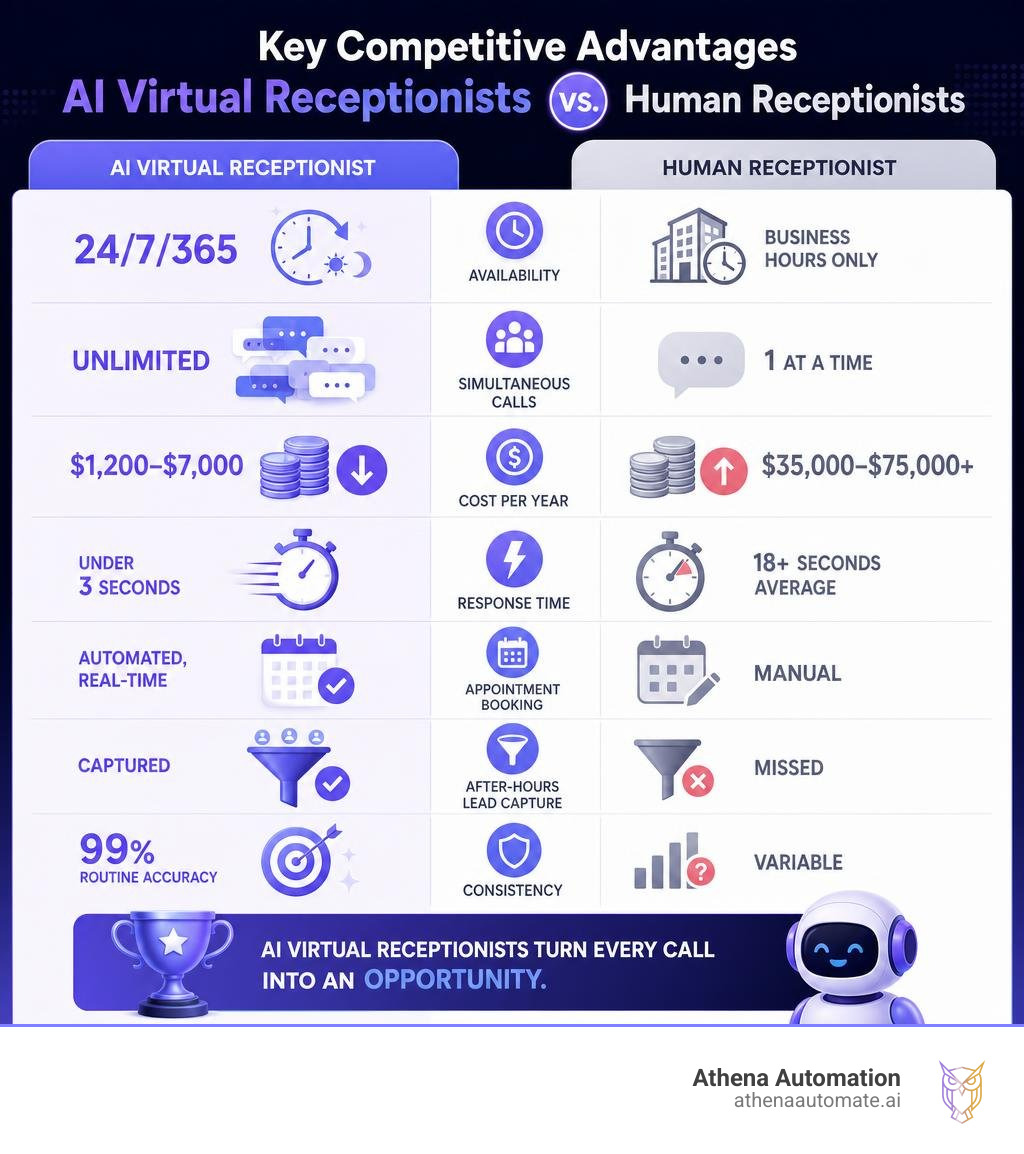
Here is the short version of what that advantage looks like:
| Competitive Factor | Human Receptionist | AI Virtual Receptionist |
|---|---|---|
| Availability | Business hours only | 24/7/365 |
| Simultaneous calls | 1 at a time | Many at once, within the usage agreed in your proposal |
| Cost per year | $38,010 median wage (May 2025), before taxes and benefits | Priced and scoped per business |
| Response time | Delayed when busy or closed | Answers instantly |
| Appointment booking | Manual | Automated, real-time |
| After-hours lead capture | Missed | Captured |
| Consistency | Variable | Follows your script every call |
The research, though dated, points one way. A 2014 destinationCRM report, citing Forbes, said 80 percent of callers sent to voicemail do not leave messages — so if nobody picks up, that lead may simply be gone. And plenty of folks call when it suits them, not you — early mornings, late nights, weekends. A 2016 study by 411 Locals, which monitored 85 businesses for 30 days, found 37.8% of calls were answered, another 37.8% went to voicemail, and 24.3% got no response at all.
For a local outfit — a dental office, an HVAC company, a law firm — every unanswered call isn't just a nuisance. It is a dollar figure walking out the door.
This guide lays out exactly how AI virtual receptionists are shifting the competitive ground, what the technology actually does, and how to tell whether it is the right move for your shop.
I go by Twain — the pen name our content agent writes under, with a tip of the hat to Samuel Clemens — and I have spent a good many tokens reading up on how a well-built AI virtual receptionist turns missed calls into booked work and a little breathing room for the folks who run the place. In the sections below, I will walk you through every piece of it in plain language.
What a Modern AI Virtual Receptionist Actually Is
Before we get into the advantage itself, let's be clear about what a modern AI receptionist even is. We are a long way from the robotic, teeth-grinding phone menus of years past. Today our Agents answer the phone with a natural, conversational voice — they listen, they catch your meaning, they handle interruptions, and they work things out on the fly.
When a customer calls a business running an Athena Automation AI receptionist, they don't get a stiff list of "press 1 for sales, press 2 for service." They get a warm voice that answers as soon as the phone rings, and a back-and-forth that flows like a conversation with a sharp receptionist at a front desk in Las Vegas or Henderson.
How It Beats Voicemail and Old Answering Services
To see why this matters, look at what businesses have leaned on for decades:
- Voicemail: The old "voicemail graveyard." When, per that 2014 report, 80 percent of callers sent to voicemail do not leave messages, an answering machine is just a polite way of telling your leads to go call somebody else. Zero conversation, zero help.
- Traditional answering services: These do put a live person on the line, but they come with steep catches. They often bill by the minute or by the call, or charge a flat monthly fee, and many small business plans cost $135 to $400 a month (more when a busy month triggers overage rates). Basic plans often cover message-taking only, and appointment booking into your calendar usually costs more. Operators also typically answer for many client businesses, so they won't know your service menu the way your own team does.
- AI virtual receptionists: Our Agents don't just take a message — they finish the job. They check your calendar, see what's open, book the appointment, answer real questions about your services, qualify the lead, and update your CRM on the spot. No hold music, no night-and-weekend surcharge.
Why It Sounds Human Now
The thing that makes a modern AI receptionist feel natural is what's under the hood. Older setups stacked three steps on top of each other: turn the caller's voice into text, write a text reply, then turn that reply back into speech. All that stacking left an awkward pause before every reply that nobody enjoyed.
Newer systems cut down that relay, so the reply comes back quickly enough that the call feels like a real conversation rather than a queue of recorded prompts.
The AI Virtual Receptionist Competitive Advantage, Explained
In crowded markets like Las Vegas and Henderson, being quick to answer is the whole ballgame. When somebody needs an emergency plumber or a last-minute dental chair in Summerlin, they are not going to sit around waiting for a callback. The business that answers first wins the customer. Full stop.

Put an AI receptionist on your front desk and it stops being a cost center and starts being a revenue engine that never clocks out. Your brand looks better because no caller ever gets put on hold or dumped to voicemail. And your in-office staff finally get to stop answering the same three questions all day and put their attention on the people standing right in front of them.
Why 24/7 Availability Is Such a Big Edge
The old 9-to-5 schedule just doesn't fit how people live anymore. Folks go looking for services when they have got a free minute — late at night, early in the morning, or smack in the middle of the weekend.
An AI receptionist gives you true 24/7/365 coverage with no overtime, no night shift, no holiday bonus. A call at 2:00 PM on a Tuesday and a call at 2:00 AM on a Sunday get the same polite, instant, helpful answer. You are open for business even when the office is dark — scooping up opportunities while your competitors are fast asleep.
Catching the Leads Who Call After Hours
Like I mentioned up top, plenty of customers call when the office is closed — nights, early mornings, weekends. Staff them the traditional way and those calls roll to voicemail, where most folks hang up and dial the next name on the list.
With an AI receptionist, you can actually go capturing those missed calls with Athena Automation instead of feeding them to the voicemail graveyard. The Agent qualifies the lead, gathers their details, answers the early questions, and books them right into your calendar. As an illustration: if you caught one after-hours caller a week and each one became a $500 job, that would be $26,000 a year of work that would otherwise have gone to voicemail.
AI vs. Human Receptionists: Cost, Consistency, and Scale
Human receptionists bring real empathy and sharp problem-solving to the tricky stuff, and that is worth a lot. But they are bound by the limits of being one person: one call at a time, breaks, sick days, and a fair bit of money to hire, train, and keep.
Here is how the two stack up across the metrics that actually move the needle:
| Operational Metric | Human Receptionist | AI Virtual Receptionist |
|---|---|---|
| Simultaneous Call Capacity | 1 call (others go to hold/voicemail) | Many calls at once, within the usage agreed in your proposal |
| Pickup | Several rings; often to voicemail | Answers when the phone rings |
| Routine Tasks | Manual data entry | Follows your rules on every call |
| Training & Onboarding | Usually a few days up to a month of on-the-job training | Once it's wired in and tested |
| Turnover | A departure means rehiring and retraining | No resignations to cover |
| Multilingual Capabilities | Limited to hired staff languages | Can be set up for more than one language |
The Money: AI vs. a Full-Time Hire
A full-time receptionist is no small line item. The U.S. Bureau of Labor Statistics puts the May 2025 median receptionist pay at $38,010 a year, before payroll taxes, benefits and paid time off. For the full loaded-cost math, see our AI receptionist vs. hiring a front desk comparison; the edge this page is about is the calls a single desk cannot reach.
Our AI receptionist, by contrast, is priced and scoped per business, with its monthly usage set out in your proposal, and it can handle far more calls at once than one person at a desk. Our Pricing page explains how we scope it.
Handling a Flood of Calls at Once
One of the toughest spots for a growing business is the peak-hour rush. If three customers call at the same moment, a human receptionist can only talk to one. The other two get hold music or voicemail — a sour experience and a real risk of lost business.
Our Agents settle this with something called multi-threading. One Agent can carry many conversations at once. Nobody hears a busy signal, a long hold, or a phone ringing into nothing. That capacity, within the usage agreed in your proposal, lets you ride out a sudden spike — a seasonal push, a local storm — without scrambling to hire temps.
Features, Integrations, and Industry Rules
A modern AI receptionist doesn't work off in a corner by itself. To actually deliver an edge, it has to plug into the software you already run your business on.

Automatic Scheduling and CRM Integration
Most folks who call a business want to book a service, ask a question, or set up a consultation. An AI receptionist loaded with Athena's AI receptionist features hooks straight into your digital calendars (think Google Calendar, Outlook, or an industry scheduler) and your CRM.
When a customer calls, the Agent can:
- Spot a returning customer by matching their phone number in your CRM.
- Check what is actually open on your calendar right now.
- Offer time slots that fit what the caller wants.
- Book it on the spot, fire off a confirmation, and set up SMS reminders.
- Drop a full transcript and call summary right into the customer's CRM record.
Automate that whole loop and you knock a heap of busywork off your team's plate. For hospital appointments, a 2011 systematic review in the Journal of Telemedicine and Telecare found automated reminders cut non-attendance by 29% of the baseline value.
Built for Your Industry, Compliant Where It Counts
Every industry runs differently and answers to different rules, so a generic, out-of-the-box assistant rarely cuts it. That is why we build custom, industry-specific AI agents tuned to exactly how local businesses operate:
- Dental & Medical Practices: Patient privacy comes first, so ask any vendor how it handles HIPAA, what security reports it can show, and how data is encrypted. Our dental and medical Agents can integrate with health-record systems, subject to API access and scoping, so patients can book visits and request refills.
- Law Firms: Legal intake needs airtight confidentiality, conflict checks, and a fast response. Our setups for law firms capture new client inquiries the second they come in, qualify them by practice area, and route them the right way.
- Home Services & Contractors: For plumbing, HVAC, and electrical, speed is everything. Our Agents for home services can be set up to flag emergencies to your on-call tech, quote the service-call fee you set, and book the repair.
- Real Estate: Agents are out showing property half the day. Our real estate Agents field availability questions, set up showings, and capture buyer leads around the clock.
- Restaurants: Reservations, takeout, and party bookings can bury the host stand during a dinner rush. Our Agents for restaurants handle reservations and answer the usual questions about the menu, hours, and dietary needs.
- Country Clubs: Members expect white-glove service. Our solutions for country clubs help with tee-time bookings, dining reservations, and event sign-ups without a hitch.
The Hybrid Model: AI and Humans, Side by Side
A lot of folks figure an AI receptionist means firing the whole front desk. It doesn't. The businesses that do this best run a hybrid model — our Agents and your people working side by side.
In that setup, the Agent is the first line. It answers every call right away, screens out spam, handles the routine stuff (directions, hours, basic bookings), and qualifies leads. That clears the bulk of the simple, repetitive call volume off your team, so your skilled people can spend their time on the complicated, high-value, or tender conversations that really do need a human heart.
When to Hand Off: The Live Transfer
The trick to a good hybrid model is a clean handoff. The Agent knows its own limits. If a caller brings a knotty problem, sounds upset, or just plain asks for a person, the Agent transfers the call to a team member right away — and it carries the context along. It passes a quick text summary or a screen pop of what has been said, so the customer never has to tell their story twice. That feels professional, and it feels like somebody is actually paying attention.
The Payoff: The Financial Edge of Going Hybrid
A hybrid setup can pay off where it counts. Handing the routine calls to our Agents can take repetitive phone work off your staff's plate — time that would otherwise go to answering the same handful of questions. That time gets poured back into reaching out to clients, better in-person service, and actually growing the place.
So before you decide, count what your missed calls are worth: an Agent that answers after hours gives those callers somewhere to land besides voicemail.
Frequently Asked Questions About AI Receptionists
How much does an AI virtual receptionist cost compared to a human receptionist?
The May 2025 median receptionist pay was $38,010 a year, before payroll taxes, benefits and training. Our AI virtual receptionist is priced and scoped per business, with its monthly usage set out in your proposal, and it can answer many calls at once, day or night.
Can an AI receptionist actually book appointments, or just take messages?
It books. Our Agents connect to your calendar and CRM, check what is open in real time, offer slots that fit the caller, lock in the appointment, send confirmations and SMS reminders, and log a full call summary to the customer's record. For hospital appointments, a 2011 review found automated reminders cut non-attendance by 29% of the baseline value.
Does it really answer calls after hours and on weekends?
Yes — true 24/7/365 coverage with no overtime, night shifts, or holiday pay. Plenty of customers call outside normal hours, and a 2014 report citing Forbes said 80 percent of callers sent to voicemail do not leave messages, so an Agent that picks up at 2:00 AM on a Sunday gives those callers somewhere to land.
How accurate is an AI receptionist, and what happens on a complex call?
Our Agents follow the script, rules and calendar you set on every call instead of retyping details by hand. When a call turns complicated or emotional, or the caller asks for a person, the Agent hands off to a live team member and passes along a summary, so the customer never has to repeat themselves.
Conclusion
The front desk isn't a desk in a lobby anymore — it is the digital front door to your whole business. In a market where speed, availability, and smooth service decide who wins, leaning on old voicemail or a slow, pricey answering service is a wide-open weak spot.
The advantage comes down to this: it answers the call that would have gone to voicemail, captures after-hours leads, and takes on a rush without a temp hire. Automate the routine, protect your team's time for the exceptional, and you outsmart your competitors one well-handled call at a time.
If you are ready to quit losing leads to voicemail and want to hear what a custom, human-grade AI voice Agent can do for your business, that is exactly what we build. At Athena Automation, we put together custom AI Agents tuned to your workflows and take them live once they're wired in and tested. Reach out today, or jump into our Chat to start building your front-desk solution.