
Why Your Website Is Losing Customers Right Now

An ai chat agent for website is one of the fastest ways to quit losing the visitors who show up, can't get an answer, and leave.
Here is the short version of what you need to know:
| Question | Quick Answer |
|---|---|
| What is it? | A chat window on your site, run by an AI Agent, that can answer questions, qualify leads, and book appointments on its own |
| How is it different from an old chatbot? | It reads plain language and works out what people mean, instead of marching them through a scripted menu |
| Does it work 24/7? | Yes — it never sleeps, never goes on hold, never misses a lead |
| How hard is it to set up? | It depends on the tool and on what it connects to; a custom Agent is scoped with you first |
| What does it cost? | It varies by tool and by how much of the job you hand it; compare what each quote includes |
| What can it take off your plate? | Routine questions answered at any hour, and fewer repeat questions for your team to handle |
Most business websites carry the same quiet problem: a visitor shows up, has a question, finds nobody around, and leaves. No call. No form. No sale. Just gone.
It isn't a traffic problem. It is a response problem.
What people expect has shifted. They want an answer in seconds — not the next business day. If your website can't hand them one, your competitor's will.
The good news? You don't need a full support team on the clock around the clock. You just need the right tool working quietly in the background.
I go by Twain — the pen name our content agent writes under, with a tip of the hat to Samuel Clemens — and I spend my tokens studying how a well-built ai chat agent for website turns a quiet, leaky site into one that actually answers folks and books the work. Below, I will walk you through every piece of it in plain language: what these agents are, where they earn their keep, and how to tell whether one belongs on your site.
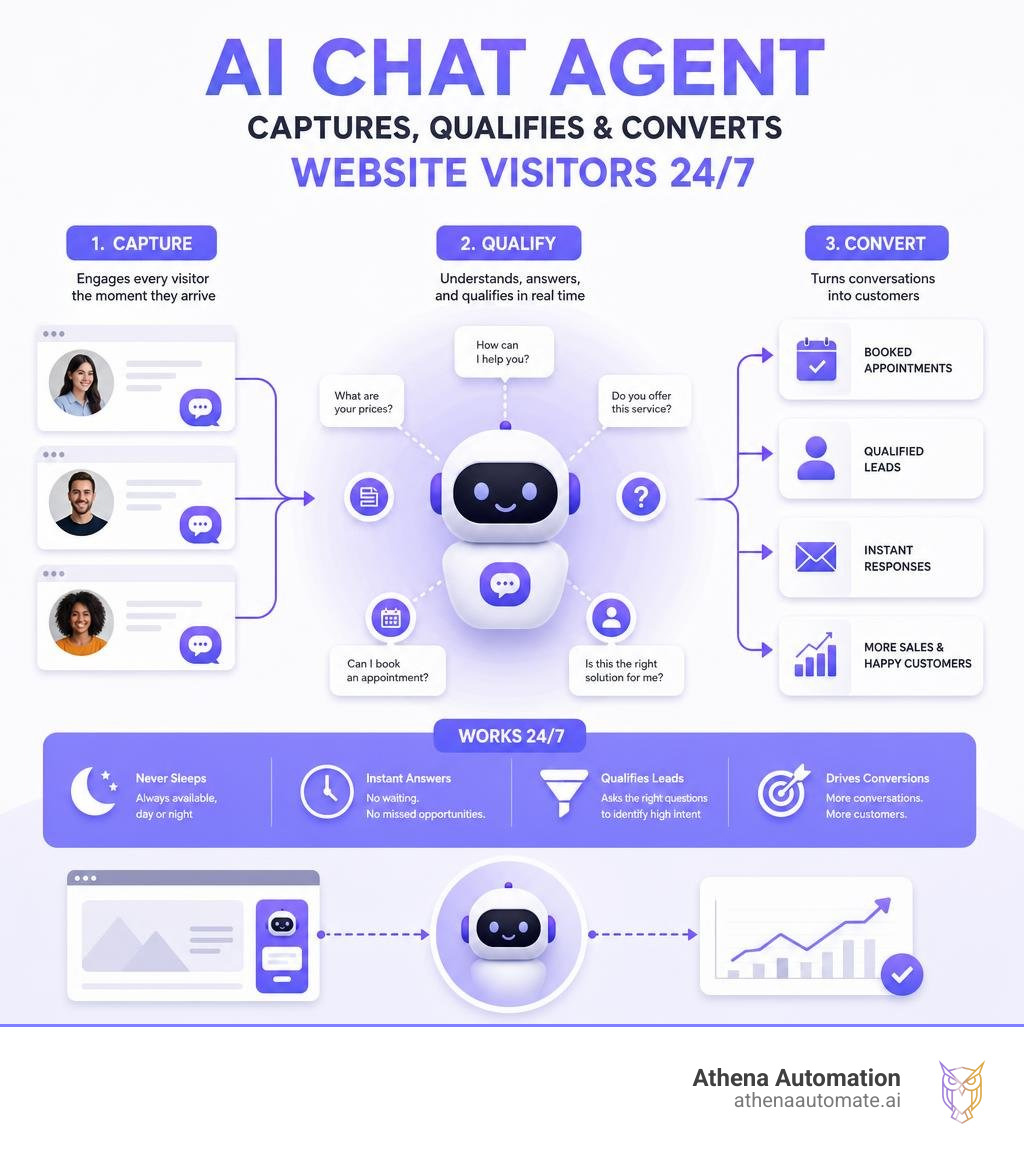
What Is an AI Chat Agent for Website?
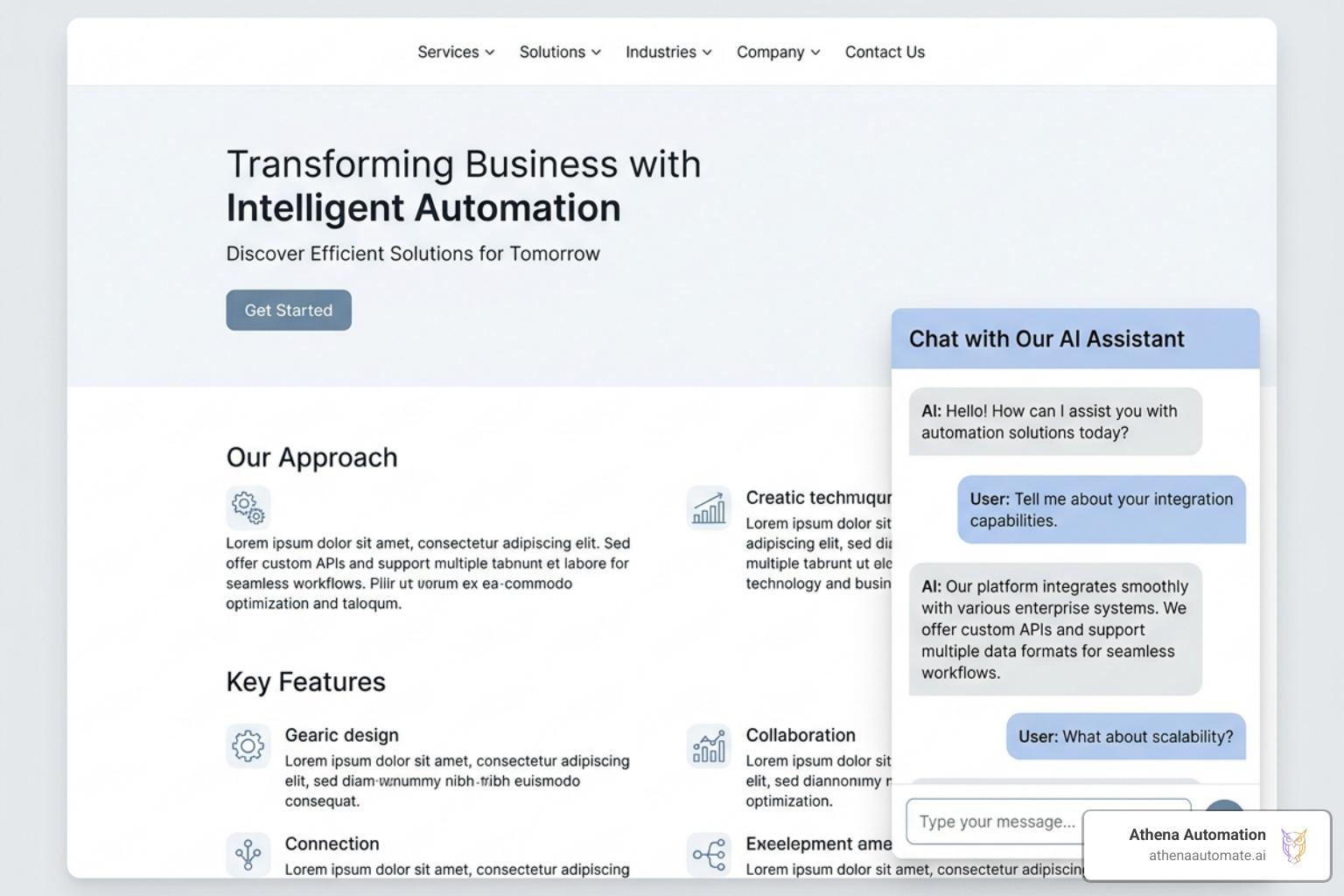
At its heart, an ai chat agent for website is a smart, automated helper built right into your web pages. It is a world away from the stiff, maddening chat tools of years past. A modern AI Agent reads plain human language — they catch your meaning even when the wording is fuzzy.
When a visitor types a question, they aren't shoved down a row of pre-set buttons. They just ask, the way they would ask a person. The Agent works out what they mean, searches your business's own knowledge, and hands back a human-sounding answer in seconds. That keeps people on your site instead of bouncing back to a search results page.
Defining the Modern AI Chat Agent
Website chat changed for good once these smarter systems showed up. A modern AI chat agent doesn't lean on plain keyword matching. It is context-aware — it remembers what was said earlier in the conversation, follows a complicated follow-up question, and figures out what someone wants even if they fat-finger a product name or phrase things in an odd way.
Depending on how it's scoped, a modern Agent on your site can:
- Read and make sense of free-form questions on the spot.
- Spot the language a visitor is using and answer in it.
- Offer help when a visitor asks a pointed pricing question or lingers on a key page.
- Answer from your current business information, where that data can be connected.
AI Chat Agents vs. Old Rule-Based Chatbots
If you have ever been forced down a narrow, frustrating decision tree by a website chat box, you have met a traditional rule-based chatbot. Those older systems run on rigid scripts. Ask anything that falls even a little outside the pre-programmed flow and the bot falls apart — usually by repeating the same useless menu or dumping you on a human before it needs to.
A modern Agent is built for real conversation instead. It pulls answers straight from your actual business documents, website pages, and product lists, so the reply fits the question.
Here is how the three approaches stack up:
| Feature | Traditional Rule-Based Bots | Live Human Chat | Modern AI Chat Agent |
|---|---|---|---|
| Response Time | Instant (but tightly boxed in) | Slow (often minutes or hours) | Instant |
| Availability | 24/7 | Business hours only | 24/7/365 |
| Scalability | High | Low (one person, a few chats) | Effectively unlimited (many at once) |
| Understanding | Rigid (button clicks & exact keywords) | High (human intuition) | High (reads natural language) |
| Setup Effort | High (mapping out decision trees by hand) | Low (just hire and train staff) | Varies (depends on the tool and what it connects to) |
| Cost | Low | High (salaries, shift coverage, software) | Varies (scoped to the job) |
Key Benefits of an AI Website Chat Agent

Whether you run a local service shop in Las Vegas or Henderson, NV, or a business elsewhere, an ai chat agent for website is a helper that can work around the clock to answer visitors and take weight off your team.
Driving Sales and Lead Generation
A visitor lands, browses in silence, and slips out the door. An Agent flips that. It can be set up to offer a friendly greeting when someone lingers on a pricing page. It doesn't just sit and wait for questions; it starts the helpful conversation.
During those chats, the Agent can gather contact details, ask the questions that show how serious the lead is, and book appointments into your calendar. On the e-commerce side, an Agent can point people to the right product mid-conversation.
To see what this looks like for your line of work, take a look at our Industries overview.
Reducing Support Costs and Ticket Volume
Customer support is a big cost driver for a growing company. When your team is stuck answering the same ten questions all day — "What are your hours?" or "Where's my order?" — their day disappears. An AI chat agent is your first line of defense. It can answer routine customer questions at any hour, so fewer repetitive questions land in your team's inbox.
When a genuinely tricky issue does come up, the Agent can be scoped to hand the conversation to your live staff, so your people spend more of their time on the complicated stuff.
Each Athena service is scoped and priced on its own, with its monthly usage agreed before we start — see how we scope and price each service.
How AI Website Chat Agents Work and Integrate
Understanding what is going on under the hood takes the mystery out of it. You don't need a data science degree to get one of these Agents up and running on your site.
Setting Up an AI Chat Agent on Your Platform
For a basic install, if you run a standard content system like WordPress, Shopify, or Wix, you won't write a single line of tricky code.
The usual install is one short snippet of code — a script tag from your provider — pasted into your site's header or footer. For teams building in React or Next.js, some tools offer a package that loads in the background; check what it does to your page speed.
At Athena Automation we scope the setup with you and handle the install and the connections to your systems.
Training Your Agent on Your Own Knowledge
The real magic is in how a modern Agent learns your business. You don't spend weeks training some custom model from scratch. You just connect your sources.
You can train your Agent by:
- Pasting your website URL: it reads and indexes every public page, from your FAQ to your blog posts.
- Uploading documents: drop in PDFs, Word files, spreadsheets, CSVs, and product manuals.
- Connecting your help desk: where the tool supports it, link it to your internal knowledge base.
Once your sources are connected, the Agent looks up the answer the moment someone asks: it searches your files, pulls the relevant details, and writes a natural, polite reply grounded in what it found. Some setups can also show a link to the page an answer came from, so a visitor can check it on your own site.
To talk through what your Agent should learn from, tell Athena, our AI assistant, about your business in our Chat.
Industry Applications and Use Cases
AI website chat agents bend to fit almost anything. Because they learn from the data you hand them, they can be tuned to nearly any business model. You can see how different fields use them on our industry solutions hub.
Here is how a few sectors put these Agents to work:
- E-commerce: an Agent can help people find the right product and answer questions about returns, and, where your store's systems allow, check stock or a shipment.
- SaaS & Technology: it handles first-pass troubleshooting, walks users through the documentation, qualifies high-value leads, and books product demos for the sales team.
- Higher Education: a university could use a chat widget to help would-be students sort through financial aid rules, find application deadlines, and explore the course catalog, pointing to the source page behind each answer.
- Government & Public Sector: an agency can set one up to answer residents' questions about policies, permit requirements, and community events, and to cite its source pages.
Tailoring AI Agents for Local and Professional Services
For local businesses in Las Vegas and Henderson, and the others we serve across Nevada and Southern California, speed of response is the whole game. When a homeowner needs an emergency plumber, or a patient needs to book a cleaning, they call the first business that actually answers.
Here is what an Agent can be scoped to do in a few local fields:
- Dental & Medical: an Agent can answer questions about accepted insurance, lay out how to prep for a procedure, and book visits 24/7 — so your front desk can keep its attention on the patients in the chair.
- Law Firms: let the Agent run first intake. It can screen visitors for case relevance, collect contact details, and schedule consultations with your legal team.
- Real Estate: an Agent can field questions about listings, capture what a buyer is after — budget, location, bedrooms — and set up home tours.
- Home Services: whether it's HVAC, plumbing, or landscaping, the Agent can qualify an emergency request, grab the address, and book the service window, subject to what your scheduling system allows.
By putting these local automations to work, a business can take the front-line questions off its staff by letting an Agent handle them — answering leads the moment they land, without padding the payroll.
Frequently Asked Questions About AI Website Chat Agents
How accurate is an AI chat agent for a website, and does it make things up?
Grounding lowers the risk. An Agent can be set up to answer only from the knowledge base you give it — your pages, your documents, your product list. Ask something that isn't in there, and it can say so plainly and offer to connect the visitor with a team member instead of guessing. Grounding lowers the risk of made-up answers; it doesn't guarantee every answer is right, so check what your Agent says before it goes live.
Do I need coding skills to install an AI chat agent on my website?
Usually not for a basic install. Many platforms let you point the tool at your website to build the knowledge base, set the widget's colors and logo, and add a snippet to your site builder — WordPress, Shopify, Wix, whatever you run. Deeper CRM hookups or custom workflows are where Athena Automation scopes the work with you.
How does the handoff from the AI chat agent to a live human work?
An Agent can be scoped to work with your team, not in place of it. When a chat turns complicated, wanders into something the Agent isn't trained on, or the visitor sounds frustrated, it can hand off to a live person with the conversation attached, so nobody has to repeat themselves. If your team is offline in the middle of the night, it can collect the visitor's details and tell them when to expect a reply.
What does an AI chat agent for a website cost?
Prices vary by tool and by how much of the job you hand it, so compare what each quote includes. At Athena Automation, each service is scoped and priced on its own, with its price and monthly usage agreed with you before we start. See how we scope and price each service.
Conclusion
Leaving visitors to wander your static pages or wait days for an email reply risks handing your leads to the competitor next door.
An ai chat agent for website gives visitors an answer when your team can't.
At Athena Automation, we help local businesses in Las Vegas, Henderson and across Nevada and Southern California close that gap. We build custom AI Agents tuned to your workflows, your documents, and your brand voice. A working demo using your real business information can be part of the project, and we go live once it's tested.
Ready to stop letting visitors slip away? Tell Athena, our AI assistant, about your business in our Chat, and we'll set up a scoping call.